Why Large Print? A Plain Guide to Bigger, Clearer Puzzles
"Large print" is not just a marketing phrase — in publishing it has a fairly specific meaning, and for puzzles it changes the whole experience of solving.
What counts as large print?
For regular books, large print editions are usually set in 16-point type or larger, compared with 10–12 points for a standard paperback. Puzzle books follow the same idea: bigger letters in the word list, bigger grids, and more space between elements so each part of the page is easy to take in at a glance.
The numbers that matter in a puzzle book
- Letter size in the grid. In a word search, the grid is the puzzle. Letters around 14–16 points or larger stay distinct — an O does not blur into a Q, and an I does not vanish next to an L.
- Grid size overall. A 13 by 13 word search printed across a full page gives every letter room. The same grid squeezed into a quarter-page is technically identical and practically much harder to enjoy.
- Sudoku squares. A sudoku printed at full page width gives each square roughly three-quarters of an inch — enough to write a comfortable, confident number, and to add small pencil marks without crowding.
- Contrast and paper. Dark, clean type on white paper, with no text printed over pictures, keeps the page calm and legible.
On paper vs. on screen
Paper has no zoom, so print size has to be right at the press. On screen there is more flexibility: the puzzles on this site are typeset large to begin with, and you can also zoom the page in your browser (usually Ctrl and the + key, or pinch on a tablet) to make any puzzle as big as you like.
Our standard
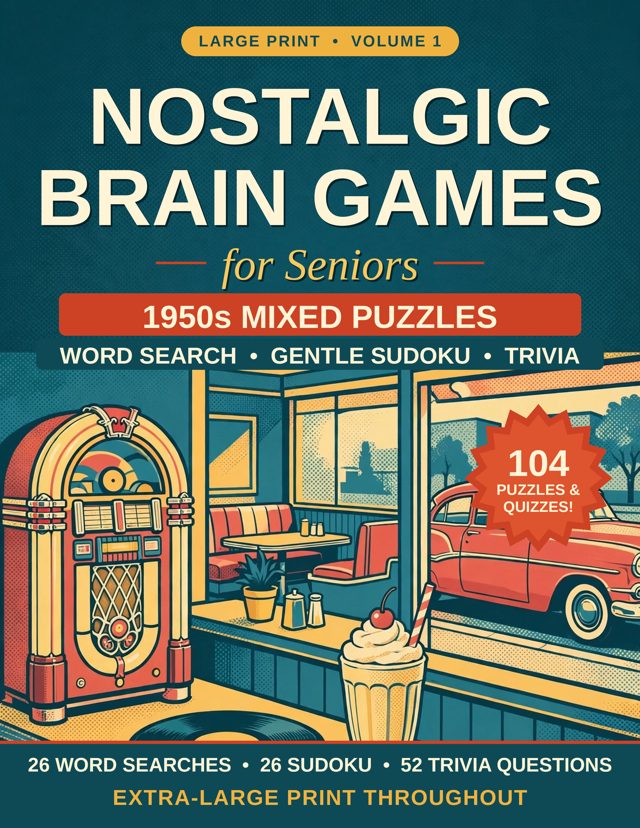
The books behind this site — the Nostalgic Brain Games for Seniors series — are printed at 8.5 by 11 inches specifically so the grids can be extra large, and this website follows the same rule: big tap targets, big letters, high contrast, nothing essential hidden in small print. If a puzzle ever feels cramped, it fails our standard, not your eyes.